Haiku, Inc. and contributors, 2024. Independent.
Haiku is a free, open-source operating system for personal computers and a community-driven continuation of BeOS. On 17 August 2001 Palm announced it had bought Be Inc., which ended BeOS development, and the next day Michael Phipps started the OpenBeOS project to build an open-source, backward-compatible replacement. Palm refused to license the BeOS code, so the project had to reimplement it. The nonprofit Haiku, Inc. has supported development since 2003, and OpenBeOS became Haiku in 2004.
Apart from Tracker and the Deskbar, which Be released as open source with BeOS 5, Haiku is original software. Its kernel began in 2002 as a fork of NewOS, written by former Be engineer Travis Geiselbrecht. Haiku is written in C++ with a programming interface based on BeOS’s, and its 32-bit version aims to run BeOS 5 programs without changes.
The first alpha release came after seven years of development, and Beta 1, in 2018, brought full package management through HaikuDepot and pkgman. Haiku is still in beta: R1/beta6 was released in August 2026, about a week after the project’s 25th birthday.
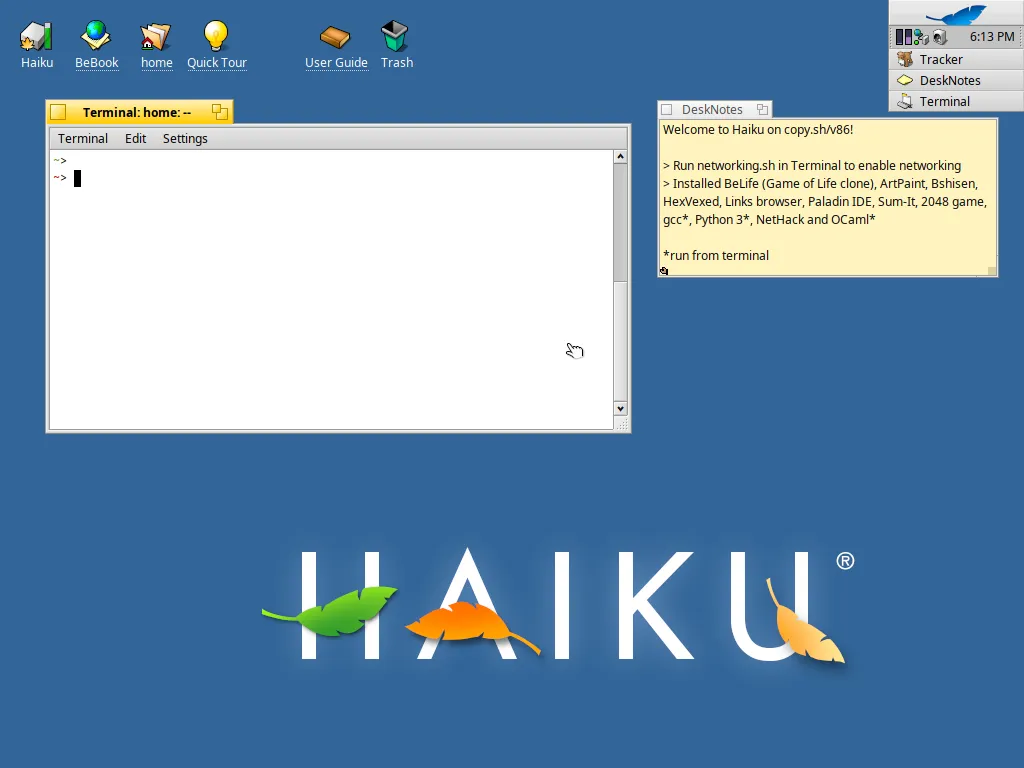
This exhibit resumes from a state saved on copy.sh, running a 32-bit Haiku build from 12 September 2024. A Terminal is open, and a welcome note lists programs added to this copy, such as ArtPaint, NetHack and Python 3.