John Andrews, 2012. Unix, BSD & Linux.
Damn Small Linux (DSL) began as an experiment by John Andrews to see how much software could fit in 50 MB, and grew into a full Linux distribution. It ran graphical programs on PCs with as little as a 486 processor and 8 MB of RAM, and it could be installed on small media such as bootable business-card CDs, USB flash drives and Zip disks.
It was first based on Model-K, a 22 MB stripped-down version of Knoppix, and soon on Knoppix itself. For five years its community included Robert Shingledecker, who created the MyDSL extension system and later Tiny Core Linux. By June 2008 MyDSL offered more than 900 extensions, and DSL could also install Debian packages once APT was enabled.
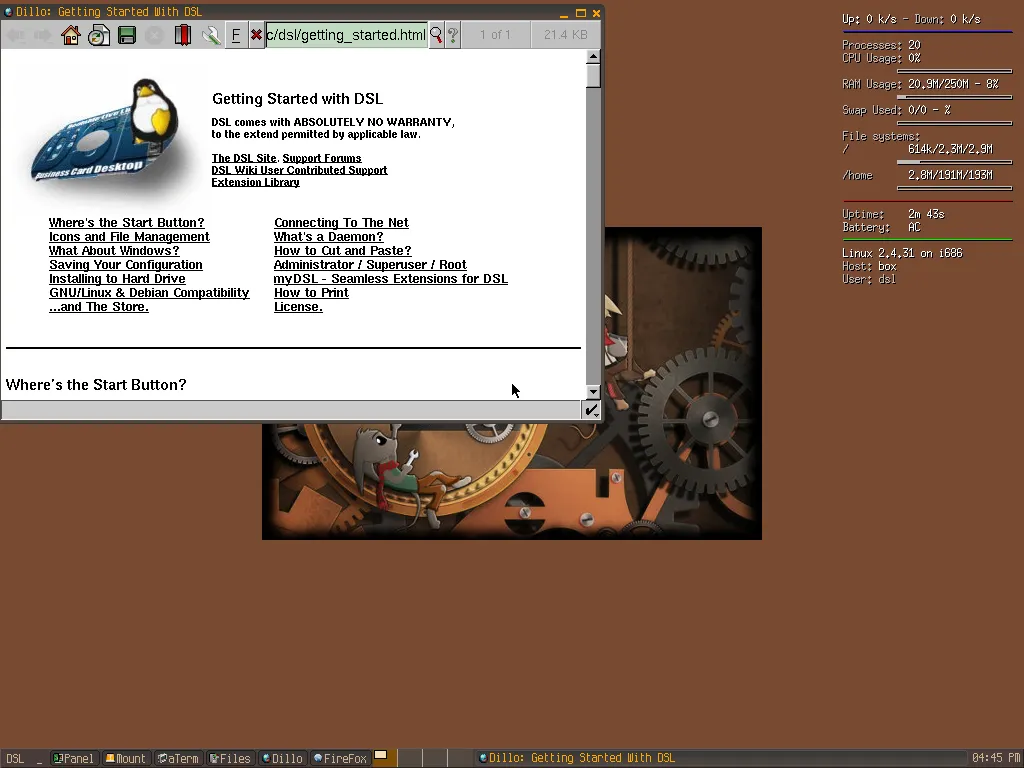
The original DSL’s last stable release came in 2008. After a long standstill, Andrews announced a new release in July 2012, and this exhibit runs its second release candidate, DSL 4.11 RC2, from 26 September 2012. In 2024 the project returned as DSL 2024, based on antiX, with a size limit of 700 MB instead of 50.